
Wednesday, June 25, 2025 · Hermosillo, Sonora
Origin Story
When I envisioned 2023, I imagined my future self doing familiar, predictable things. I’d code websites at work. I’d vacation in Mexico with my husband, Hiram. We’d go for photo walks, and I’d ask strangers — many of them musicians — for portraits on the street. Come summer, I’d work in my garden early in the morning and try to outsmart the Arizona sun to cultivate plants that aren’t okra. When the sun defeated me, I’d bike to a cafe where I’d enjoy the air conditioning and the sweet distraction of lemon cake.
I didn’t do any of those things, though. Instead, I changed jobs and began graduate school in the Bilingual Journalism Program at the University of Arizona.
The new job challenged me to think about what distinguishes the borderlands from the popular notion of the border. Meanwhile, working a full-time job while returning to school required me to attend part-time—something that contributed to my impatience at first. Once in the middle of the program, though, I appreciated the pace, as it gave me time to reflect on how I could become a more intentional writer and photographer, which was my motivation for returning to school at my age. Eventually, I’d plan for my own project (this one) that combined oral histories and photojournalism.
Why now?
I had talked myself out of attending graduate school a few times in the years that followed my 1993 completion of a bachelor’s degree in Spanish Language and Literature. Eventually, I stopped thinking about it and dug into my role as a web developer. But when the owner of the design studio where I had worked for the past seventeen years began preparing for his retirement and winding down the business, I started thinking about my next steps. In addition to applying for jobs, I applied for the Bilingual Journalism Program at the University of Arizona’s Journalism school. The program appealed to me as a way to build on my bachelor’s degree in Spanish and one in which I’d have formal guidance as I worked on improving my storytelling skills in writing and photography.
Meanwhile, the new job was an 18-month contract to design and code a digital archive of work by artists, journalists, and social justice organizations in the US-Mexico borderlands. Working full-time and going to school would be a challenge, but it would also be gratifying for me to use my development and design skills on a project that I could take to heart.
I was offered the job at about the same time I was accepted to the BJP. Because I wanted to do both, I decided to study part-time while I was working.
The Reclaiming the Border Narrative digital archive project
The Reclaiming the Border Narrative project documents U.S.-Mexico borderlands stories that extend beyond the imaginary line that dominates the media and popular awareness.
I designed and coded first a project website and then a digital archive. The project website introduced the project.The digital archive, available on the UA Special Collections website, makes the donated pieces from the project accessible to the public in the form of online exhibits.
The biggest challenge for me as the developer on the project was creating a multilingual and accessible digital archive using the existing content management system. There was a lot of learning about the archival content management software, how the team at Special Collections used it, and how and if I could extend it to meet the project requirements.
Beyond the technical challenges, my work on the project shaped my concept of the borderlands, which I’d had since I first began travelling between the U.S. and Mexico in 1985.
Acorns, bribes and Mennonite cheese
Everyone has a picture in their head of the U.S.-Mexico border. More often than not, it features a crime motif. People imagine dusty, amber-hued scenes from movies and television about drug smugglers. They think of crossings and checkpoints with uniformed customs and soldiers in bulletproof vests beneath green and camouflage uniforms who stop cars and intimidate with a litany of questions and demands: What were you doing there? Where are you going? How long will you stay? What’s in your wallet? Show me the pictures on your camera.
Each election cycle, American politicians stand for photos and press conferences in front of razor wire and iron barriers at the border to convince voters they are the right one to mollify the fears of an electorate terrified of anyone who doesn’t look or talk like them in the Home of the Brave.
And, of course, a story about a trip to Rocky Point or San Carlos wouldn’t be complete without a proud tale about a bribe paid to Mexican traffic police.
I know this because it is all a part of my experience and memory too. Working on the RBN project put it in perspective by asking me to think of what the border—an hour south of Tucson and three hours north of Hermosillo—is besides an international limit. If all of that danger is what the border is, why do I (and millions of others) continue to cross it in both directions every year?
When I think about the border, I think about Sunday trips to Nogales, Sonora, with friends in the 80s. I think about food. I think about the friends I made and the experiences I had when I took the train from Nogales to Mazatlán, long before I even spoke Spanish.
The nostalgia for those train trips, in turn, makes me fond of the golden leaves of the cottonwood trees along the railroad tracks near Imuris. The passenger trains no longer run, but each year at Christmas, I see those trees from the highway on our way to visit Hiram’s family in Hermosillo, and it all comes back to me.
I think about Spanish words I’ve learned over the years on these trips, like bellotas (acorns), mordida (bribe),and queso menonita (Mennonite cheese).
It’s clear to me now that when I think about the border, I’m not thinking of the line; I am thinking about the borderlands. The border is a geopolitical definition, the borderlands is a personal one.
Back to school
Returning to school at age 58 might have felt odd if I’d spent a lot of time thinking about it. I didn’t, though. I wanted the job, and I wanted to go back to school, even if it meant often being the oldest person in the room, including the professor.
I parachuted into the program in the spring 2023 semester in Ruxandra Guidi’s audio production course. In addition to teaching how to produce pieces for radio and podcasts, Rux encouraged the class—all BJP students— to start thinking about how the work we were doing each semester could contribute to our capstone projects.
I started thinking about the many musicians I had stopped in Mexico and asked for photos.
During the summer, I completed the “Advancing Human Rights through Documentary Media” course, taught by Filmmaker and Professor Beverly Secklinger. It was a rewarding, fast-paced seven-week online course with required readings, essays, and daily discussions with classmates and Professor Secklinger. As with any course, you’ll get out of it what you put into it. It was a welcome surprise, then, to be able to get even more out of it: Every week, there was the opportunity to participate in video calls with the filmmakers and artists whose work we studied in the course.
As a final project, Secklinger asked students to synthesize the knowledge they had gained from the course’s readings and discussions with filmmakers and other artists to develop a proposal for a participatory media project.
Once again, I thought about the Mexican musicians.
What are their stories?
It was six in the morning on New Year’s Day, 2011. I rode in a taxi to the border crossing from a bus station in Nogales, Sonora. I shared the backseat with the driver’s electric guitar. The driver told me he had played a gig the night before and came directly to his day job as a cab driver. During a bumpy silence punctuated by potholes, the driver looked at me from the rear-view mirror with a smile. “That guitar is my best friend. It’s always important to start the new year with good friends,” he said.
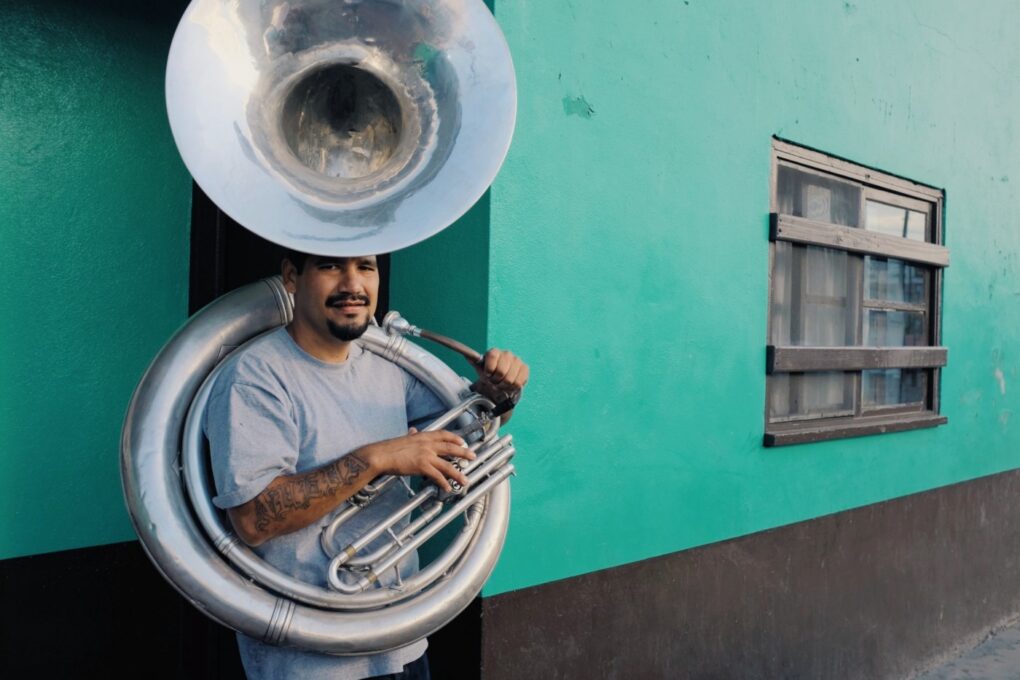
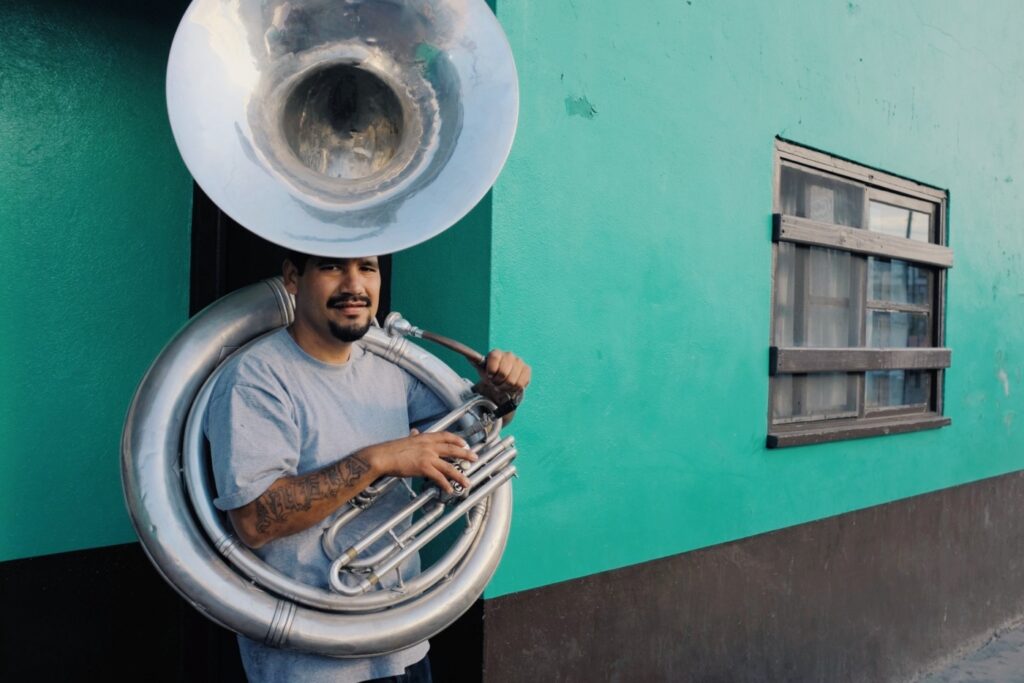
Carlos is a sturdy middle-aged man with sleepy eyes, a neatly trimmed moustache and beard and sun darkened forearms with large, blue-green tattoos. He stood out against a freshly painted teal colored wall, lips pressed to the mouthpiece of a silver sousaphone that rested on his shoulder. He reluctantly buzzed his lips against the mouthpiece and pushed the instrument’s buttons, promising a beat of melody here and there before he stopped and started again. We talked for not quite a minute. He mentioned that he came north with plans that didn’t work out, and he found himself stranded in Ensenada. He had never played an instrument, but now he was learning to play it by day before performing with a group at weddings and other events in the evenings.
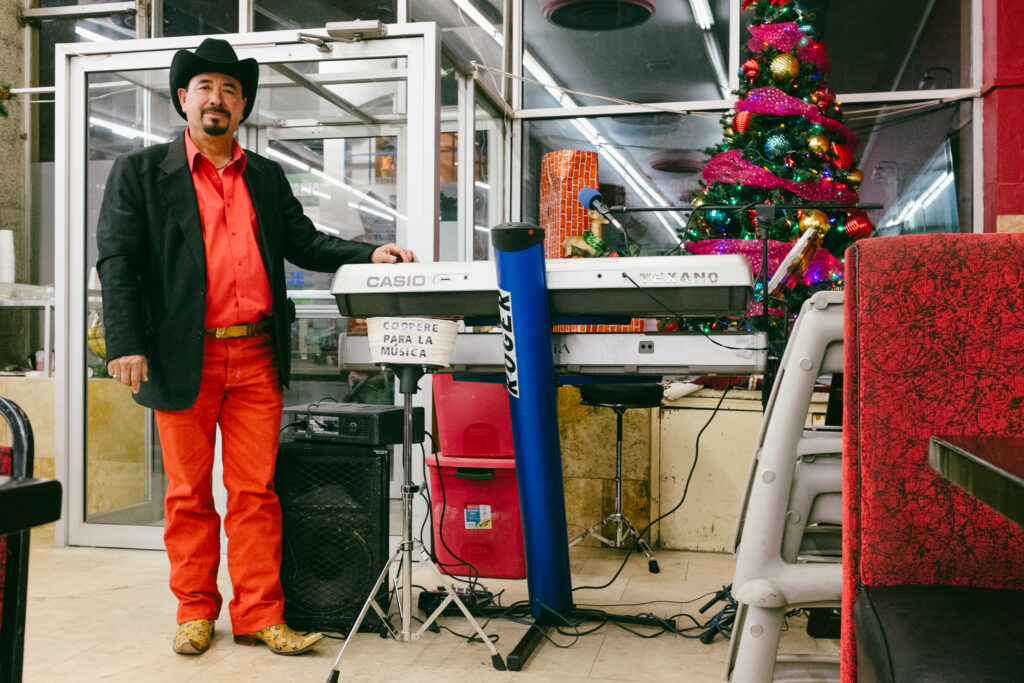
Rubén wore matching red pants and shirt, pointy, bright yellow lizard-skin boots, a black blazer, and a cowboy hat at a popular cafeteria in Ciudad Juárez. He stood at a Casio keyboard and interpreted popular norteñas such as “La camisa negra” and “Juárez es el no. 1.” During a break, we talked, again, not for very long. Rubén was a lawyer, and he performed at the cafe in the evenings. “I am an attorney who loves music.”
Each time, back home or a hotel room, I’d download the photos and think, “I bet he had some stories. I’ll never know.”
Project proposal
I drew on the bittersweet feeling of having taken photos I was proud of, while I wanted to know the stories of the people in them, to decide on this project.
In the spring of this year, I worked with my program advisor, Jessica Retis, to formalize this project, Bordernote, as the capstone project for my degree. I created a project proposal and a rough timeline. Originally, I thought I would interview and photograph musicians in all the U.S.-Mexican states that share a border. Then I would compile the images and interviews, edited into first-person accounts from the musicians in the style of Studs Terkel’s oral histories of people talking about their work. Fortunately, the task of creating that timeline, informed by my earlier experience this year putting my idea to the test in Puerto Peñasco, made it clear I’d need to narrow the scope. I’d treat this project as the beginning of an ongoing exploration of borderlands musicians’ stories.
I’d start where I was, in Arizona and Sonora.