
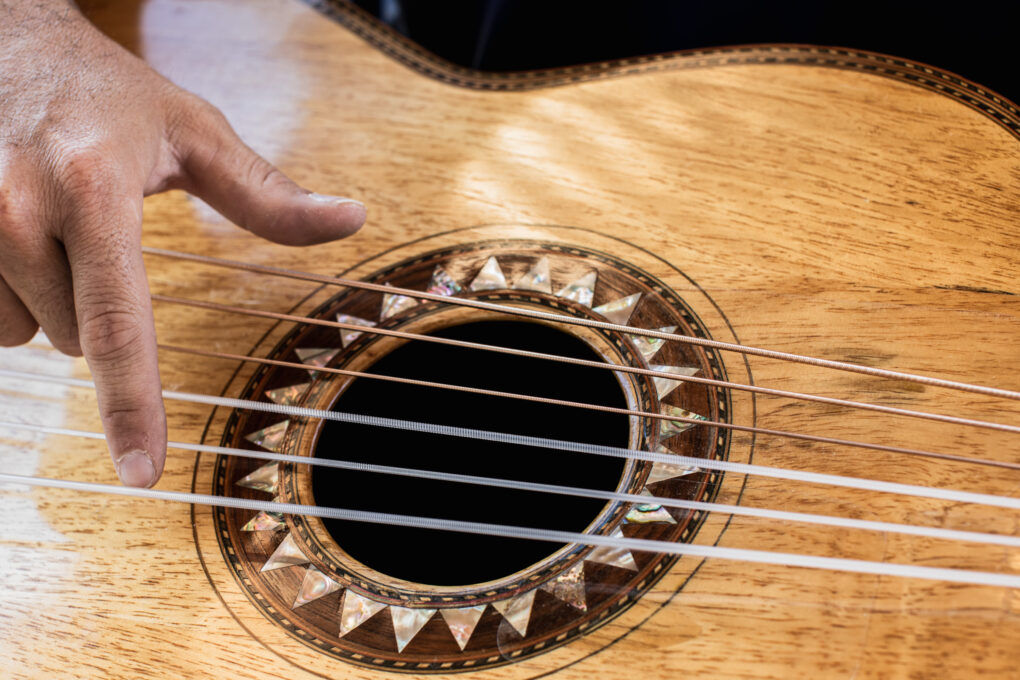
That big guitar is a guitarrón
Tucson summers linger well into October, and on Hispanic Heritage Day, the University of Arizona’s grassy mall is baked in sunshine and smells like beer and gasoline.
Michael Sanchez and the U of A’s Mariachi Arizona weaved through canyons of parked pickup trucks and football fans’ RVs. The young mariachis, with damp foreheads and midnight blue charro suits, topped off with scarlet neck bows, navigated ice chests and grills in the midday heat till they arrived at the welcoming shade of a tailgate party tent. Soon, the noise from enthusiastic day-drinkers and portable generators faded behind the mariachis’ wall of sound. The group’s trumpets, violins and the two-fourths beat that Sanchez plucked from his guitarrón’s strings were louder. The mariachis all relied on the steady twang Sanchez played to mark time as they launched into “Jesusita en Chihuahua” (“The Jesse Polka”).
Then it happened.
“My G-string just popped,” Sanchez said.
The guitarrón is what laypeople watching a mariachi group are likely to think of as “that big guitar.” Fair enough. The word guitarrón in Spanish means big guitar.
Except it’s not a guitar. It’s strung and played differently. It’s crafted with softer woods that aren’t cheap. Also, it sounds more like an upright bass, strums similar to a harp, and is light and portable enough to walk around with, even if it is as big as a saint bernard.
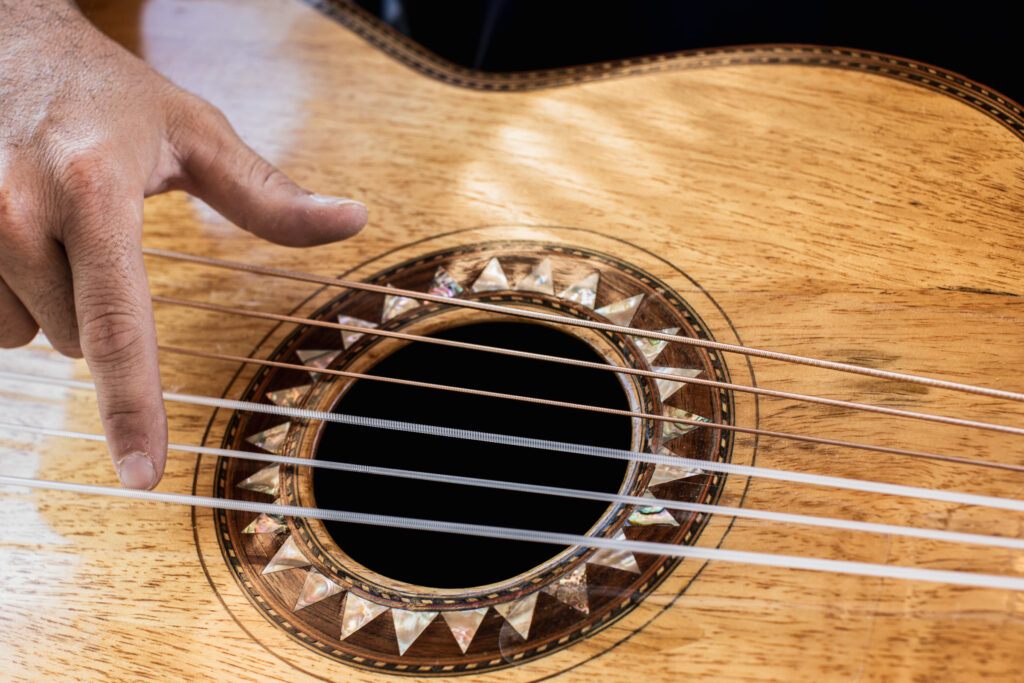
Sanchez, a 21-year-old University of Arizona history major, would have to wait until the set ended to replace the string. Still, he acted quickly and coaxed G’s from the other strings of his guitarrón for the rest of the performance.
Mariachi groups may project a formalized notion of chivalry, but the genre is nothing if not flexible. The charro (Mexican cowboy) suit is usually black wool or polyester, but a confident and well-funded group could just as easily flaunt lavender suede. Sometimes the tightly cut pants and generous skirts feature embroidery; other times, they fasten with polished buttons resembling silver coins. There’s no gender requirement, and the head count for a mariachi group can be as few as four, limited only by how many can keep up with each other. The record is more than a thousand.
Still, there are rules.
First and foremost, a mariachi group is not a mariachi group without a guitarrón. Otherwise, “It’s just a bunch of guys playing the guitars,” said Antonio Pró, a guitarrón player who performs with mariachis in Tucson and artists such as Calexico and Dean Owens.
But a guitarrón is more than its size. The other mariachis count on it to guide them. They could easily veer off course without it. Likewise, audiences feel the instrument’s bass pumping in the background, even when they aren’t consciously aware of its source.
It was that sound that drew Jesus Gonzalez-Medina to the guitarrón. Gonzalez-Medina, a 20-year-old Glendale Community College music major, discovered the guitarrón at home, listening to the mariachi music his family played.
“I would be like that’s a really nice beefy bass sound and I started liking it,” Gonzalez-Medina said.
He already knew how to play guitar before he decided to learn the guitarrón, so the differences were obvious. A guitarist strums one end of a string while pressing the other end against a raised fret on the instrument’s neck. There are no frets on a guitarrón. Instead, the player runs their fingertips up and down a string on the fingerboard, presses it, and then, with the other hand, plucks that string and another one at the same time to create an octave.
“An octave is two notes that are the same, but one is low and one is high,” Gonzalez-Medina explained.
The octave bounces around the cavernous insides of the convex-shaped cedar-back and soft wood soundboard (the front) of the instrument before it booms back out through a mother-of-pearl-crowned soundhole.
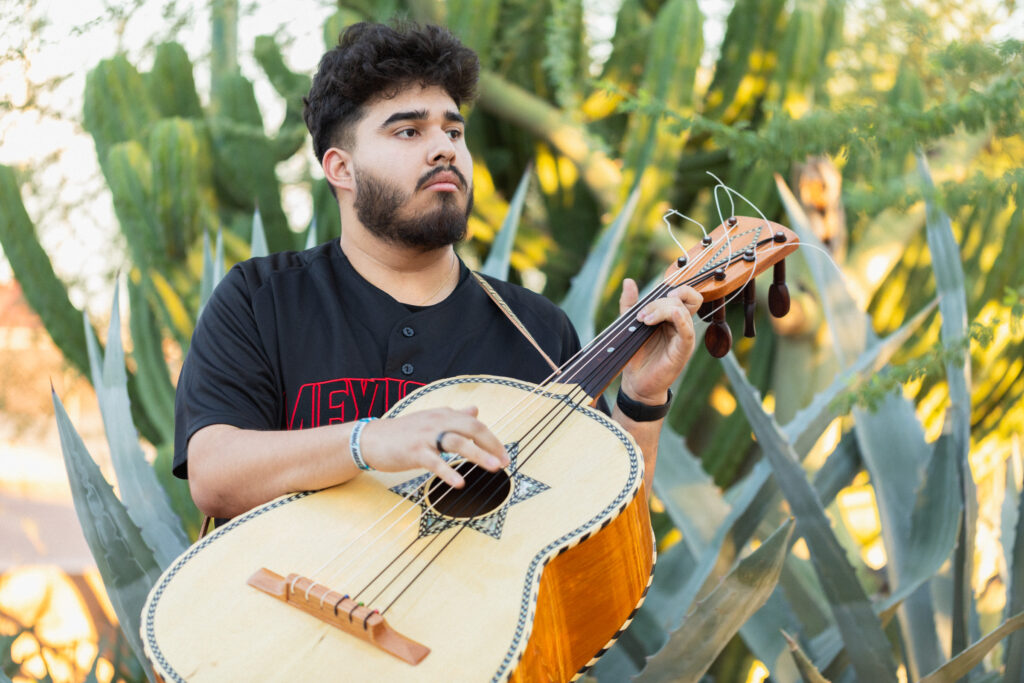
The constant slide along the three metal and three nylon strings means new players learn a method that saws away at their fingertips and leaves them raw and sometimes bloody until calluses form.
Guitarrón player Adrian Guzman, 37, is an electrician for Tucson Electric Power and a member of Mariachi Pueblo Viejo. When he talked about the guitarrón, he didn’t hesitate to share why he plays.
“It just brings me a lot of joy, just a lot of satisfaction,” Guzman said.
The duct-taped guitarrón he started with in middle school challenged him to create the best sounds with the instrument he had and made him a more confident performer.
“You know, when you first get your license, you shouldn’t be driving a Lexus. Your first car should be a beater, you learn how to tune it up,” he said.
A new guitarrón can cost upwards of $2200, according to Adan Rico, 45, a Tucson luthier. Luthiers build and repair stringed instruments.
There’s also a thriving economy of used guitarrones. Players are especially keen on those made by the Morales family of Guadalajara.
“The Morales name has been huge for the majority of my lifetime,” Rico said.
Rubén Morales, 80, began as a luthier with his father, Roberto, who died in 2017. Morales wasn’t surprised by the popularity of the resale instruments. He attributed it to skilled woodworking that creates a better sound.
Morales doesn’t service instruments made by other luthiers, but when they’re brought to him, he always looks closely for differences.
“Los otros fabricantes le ponen mucha madera. Le ponen muy, muy gruesa las maderas y la fabricación es muy diferente,” Morales said. (“The other manufacturers use a lot of wood. They make the wood very, very thick, and the workmanship is very different.”)
When Guzman found a second-hand Roberto Morales guitarrón online, he drove from Tucson to Bakersfield to buy it.
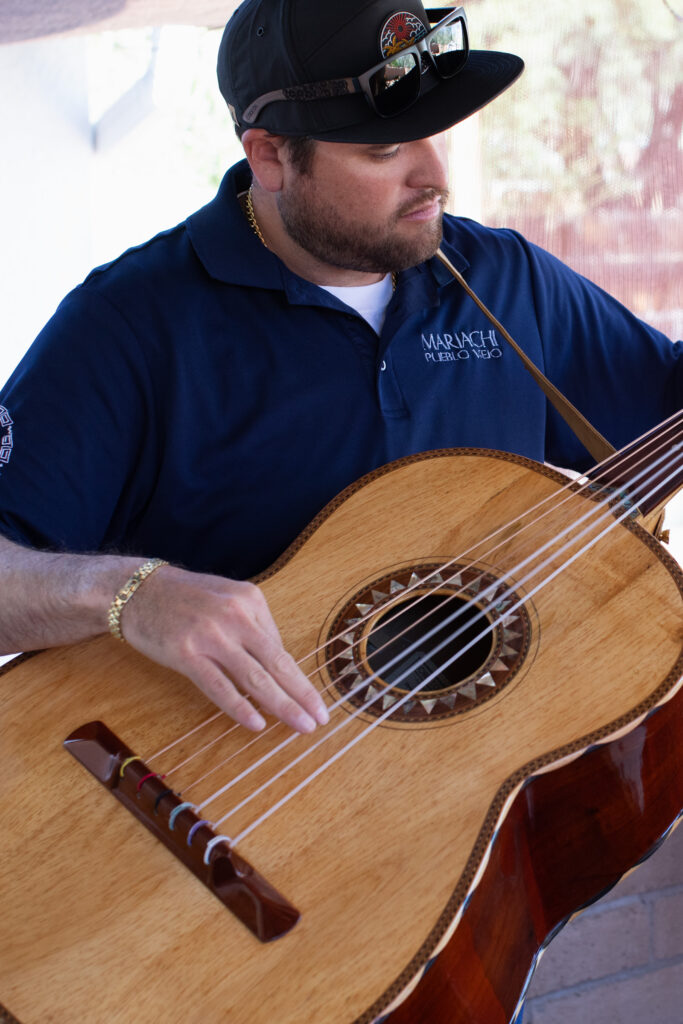
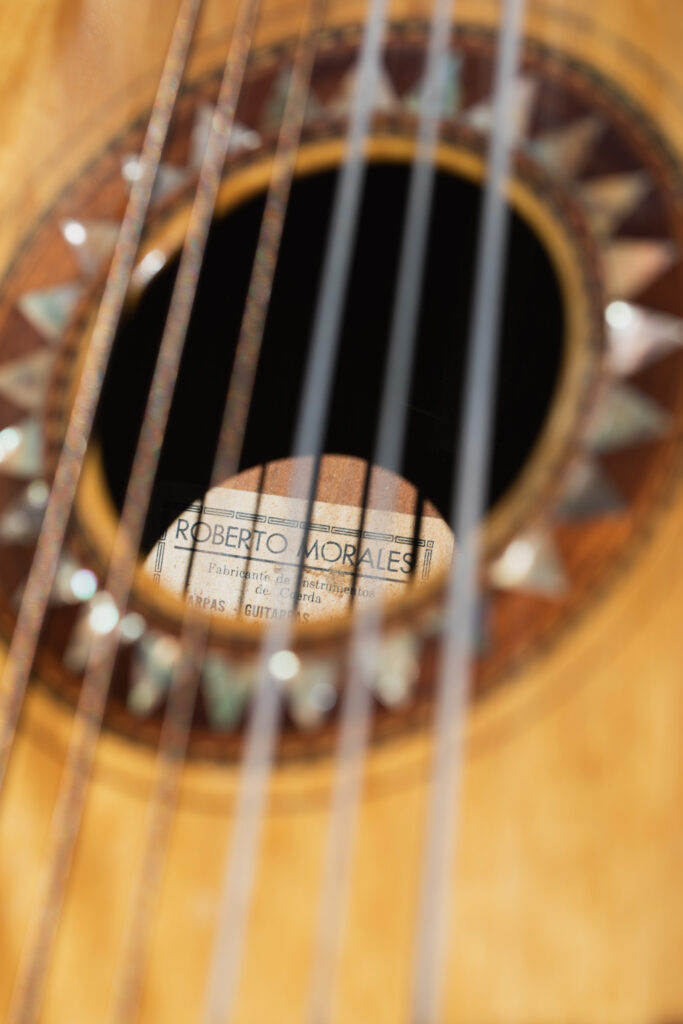
Sometimes, when Guzman is at work and in the flow of a redundant task like stripping wires, his fingers move across the insulation and his musician’s brain pictures pressing and plucking his guitarrón’s strings.
“In my head, I’m going into the motions. I would even almost consider it a form of practice,” he said.
He knows it’s not a substitute for hands-on performance, because the times life has required he put the guitarrón aside underscored the instrument’s importance for him.
“It felt like a part of me was missing,” he said.